- Who
- Alex Kataev
- What
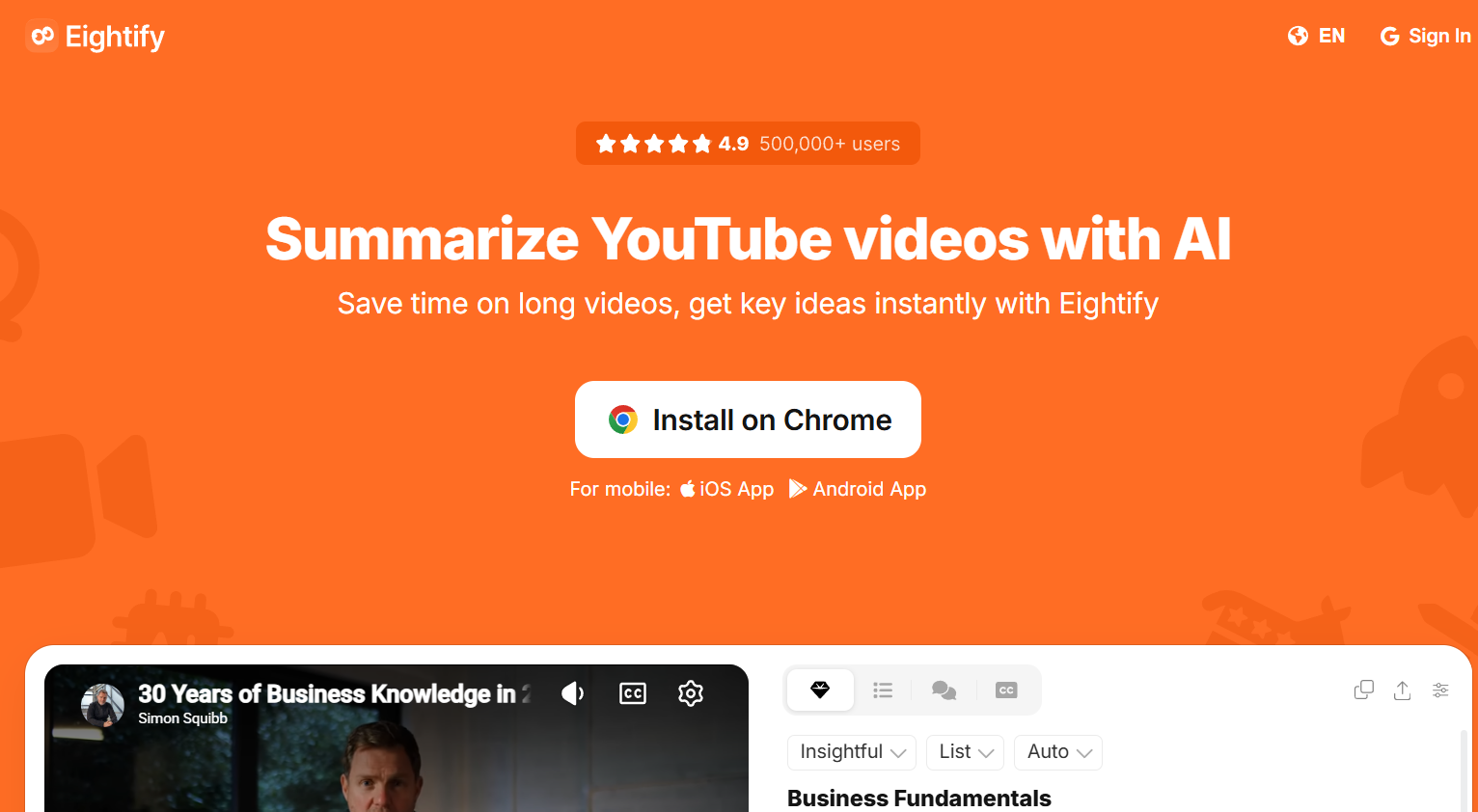
- Eightify — Chrome extension that generates GPT-powered summaries of any YouTube video in under 10 seconds
- Founded
- 2022 (prototype built in two days)
- Revenue
- ~$45,000 / month self-reported
- Source
- Starter Story · LinkedIn
$45,000 a month from a Chrome extension that tells you what a YouTube video is about before you watch it. Alex Kataev built the prototype in two days, launched in January 2023, and never raised a dollar to get there.
Alex spent seven years as a CTO at an EdTech company. He was surrounded by video content — lectures, tutorials, keynotes — and over time developed the same habit most busy people eventually develop: avoid anything over 20 minutes unless you already know it's worth it. Friends would send him hour-long videos. He'd ask what the point was. They'd summarise it in two sentences. He kept thinking: why isn't there software for that?
In late 2022, GPT-3 had just become accessible enough to act on that question. Alex saw the connection immediately: YouTube videos have auto-generated transcripts, GPT can summarise text, and a Chrome extension can run directly on any YouTube page. Three components he could wire together himself, in a weekend, without inventing anything new. He built a working prototype in two days and named it Eightify — the promise being eight key takeaways from any video, generated in roughly ten seconds.
The product answered a question every YouTube viewer has asked at least once: "Can't someone just tell me what this is about?"
He launched on Product Hunt in January 2023. Word spread immediately through developer and productivity circles — people who already felt the cost of wasted video time in their bones. Within 64 days of the original idea, Eightify had generated $590 in revenue and was seeing 500 to 800 new users per day, all organic. No paid ads. The Chrome Web Store was the entire distribution strategy: anyone searching "YouTube summary" would find it.
The freemium model did the selling. The value was visible on first use — you either felt the relief of getting the key ideas in ten seconds, or you didn't. Those who did shared it with everyone drowning in the same pile of unfinished videos. By late 2023, Eightify was clearing over $45,000 a month. Today it draws more than 70 million visitors a year and has over 100,000 users. Alex now runs it with a small team of three. No investors, no funding rounds, no pivot.
- Used the Chrome Web Store as a zero-cost app store. The store has its own search. "YouTube summary" was a query people were already running — Eightify just had to be there with an answer that worked on first try.
- Made the value visible in under 10 seconds. There was no pitch to explain. Open a long video, see eight key ideas appear instantly — that's the demo and the conversion in one. Freemium worked because the free tier proved the case immediately.
- Shipped at exactly the right moment. GPT-3 made AI summarisation viable in late 2022. Alex launched in January 2023 while the wave was still building. Early tools in a new capability category capture audience before the space gets crowded.
- Let organic word-of-mouth do the compounding. Product Hunt created a spike; productivity-obsessed users spread it through forums, Slack groups, and Twitter threads. Zero paid acquisition — ever.
- The Chrome Web Store is a free, underused app store. Millions of users search for extensions to solve in-context problems. If your tool lives inside the browser tab where the problem is already happening, the distribution is waiting for you.
- Obvious pain beats clever innovation. "I don't want to watch a 90-minute video" is not a sophisticated insight — it's something everyone has felt. The less clever the pain, the more people have it, and the faster they recognise the product.
- Two days to a prototype is the bar. Alex didn't plan for months. He saw an API, saw a pain, and connected them in a weekend. The $590 in the first 64 days wasn't about the money — it was proof the problem was real and the solution worked.
Revenue figures tagged self-reported come directly from the founder's public posts or interviews — we don't audit them. Our purpose is to share success stories with enough online proof to be worth your attention, not to certify the numbers.