- Who
- Hasaam Bhatti
- What
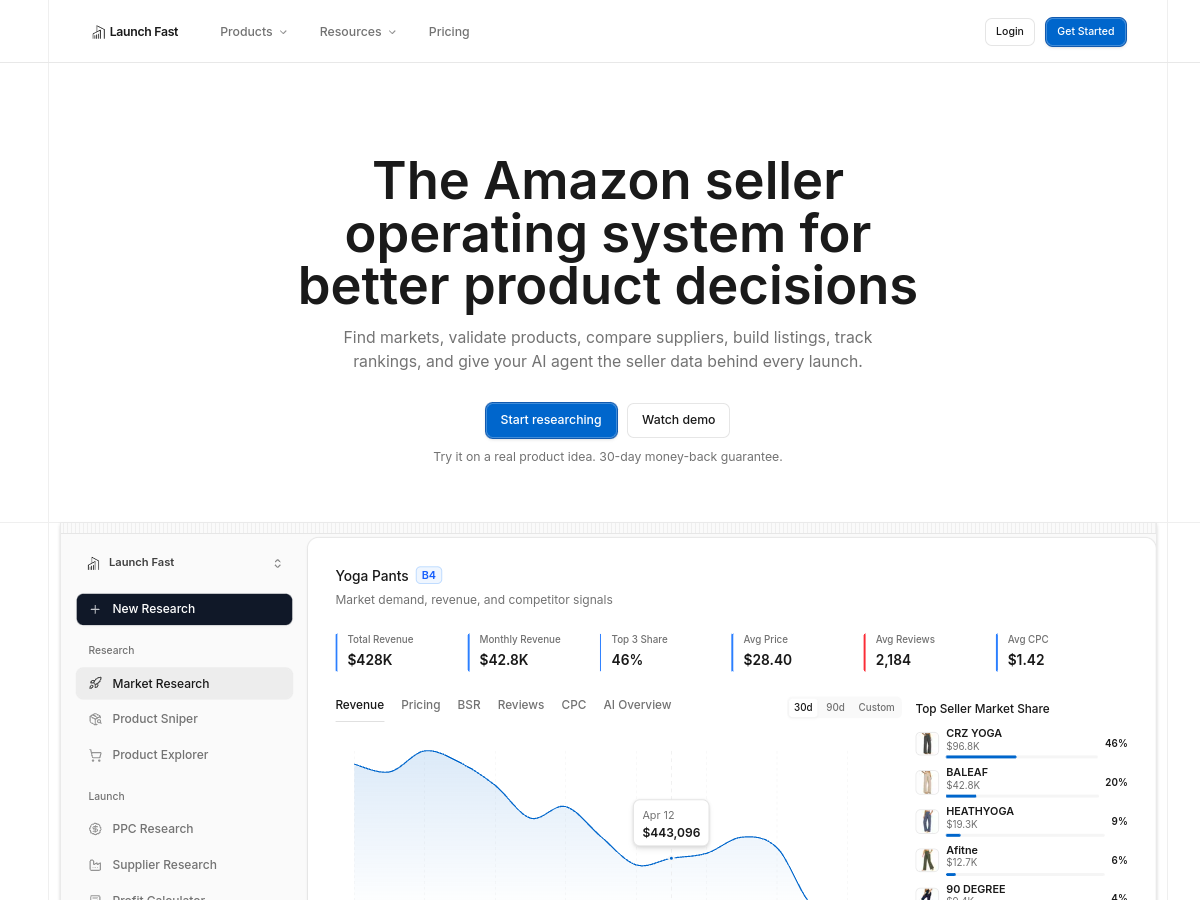
- Launch Fast — a Chrome extension and dashboard that automates Amazon product research, keyword-gap analysis, supplier sourcing, and rank tracking for FBA sellers
- Founded
- 2026 (built in a single 48-hour sprint)
- Revenue
- $30,000/month self-reported
- Source
- IndieHackers
Hasaam Bhatti had already failed ten or twelve times. Each Amazon product launch cost him 20 to 30 hours of manually copying seller data into Google Sheets, and most of those launches still didn't work. So he gave himself 48 hours to build the tool that would end the busywork for good — then pitched it, unfinished, to a coaching community with thousands of active Amazon sellers before he'd even proven it worked.
Bhatti wasn't chasing a new market. He was running two Amazon FBA brands on the side of a corporate job, and the pattern across his failed launches was the same every time: he'd pick a category he "read was big" rather than one he actually understood, then burn a full workday per product stitching together market data, keyword gaps, and supplier costs by hand across five different tools. The idea for Launch Fast came from refusing to do that math one more time.
The build itself is the part that reads like a stunt but wasn't. Bhatti isn't an engineer — by his own account he "still can't read a stack trace without AI help" — so he spent the first four hours mapping his existing workflows and spreadsheets with no code at all, then handed the core build to Cursor for the next eight hours, followed by rounds of testing, UI polish, edge-case fixes, and a demo video, all inside a single 48-hour window. Before he wrote a line of it, he'd already made the pitch that mattered more than the code: "Give me 48 hours to build the solution. If you like it, we partner." Legacy X, a coaching program with thousands of active Amazon sellers, confirmed the deal the next morning.
The 48 hours weren't a confidence trick — they were a deadline with a real person waiting on the other end of it, which is a different kind of pressure than a self-imposed one.
Revenue moved fast because the audience was already warm: $10,000 a month by day 30, $17,000–$18,000 by day 60, $21,800 by day 90, and $30,000 a month a few months later, across three public pricing tiers ($49, $89, $199) plus a separate plan for Legacy X's own members — no free tier, 330 paying users. Bhatti has since admitted the early months ran on manual effort that capped growth around $10K MRR, and he's now rebuilding the backend around automated data pipelines instead of hand-run tasks.
- Traded equity for a warm audience instead of launching cold. Bhatti pitched Legacy X's existing coaching community before the product existed, skipping the slow, expensive work of finding his first 300 customers one by one.
- Built inside a problem he'd personally lived ten-plus times. Every workflow Launch Fast automates was one Bhatti had done by hand across his own failed Amazon launches — he wasn't guessing at the pain point.
- Let an AI coding tool cover the skills gap. A founder who can't debug a stack trace shipped a working product engine in a single weekend by treating Cursor as the engineering team.
- Stacked five distribution channels instead of betting on one. Weekly training sessions, SEO content, free calculator tools, paid Meta ads, and referrals from product quality all feed the same funnel.
- Domain knowledge beats market size. Ten-plus failed launches in categories he'd only read were big taught Bhatti that living inside a problem matters more than the size of the opportunity.
- Distribution can be traded for, not just earned. An equity-for-access deal with an existing community skipped the cold-start problem — a lever available to more builders than most assume.
- "Non-technical" is no longer disqualifying. A founder who needs AI help to read a stack trace shipped a working product in 48 hours by treating an AI coding tool as the engineering team.
Revenue figures tagged self-reported come directly from the founder's public posts or interviews — we don't audit them. Where a figure is independently reviewed by outside press, we note that instead. Our purpose is to share success stories with enough online proof to be worth your attention, not to certify the numbers.