- Who
- Bhanu Teja Pachipulusu
- What
- SiteGPT — AI chatbot that trains itself on any website in minutes and answers visitors' questions instantly
- Founded
- 2023 (built in 2–3 weeks, solo)
- Revenue
- ~$250,000 / year (~$20K+ MRR combined portfolio) self-reported
- Source
- Starter Story · Superframeworks · Mixergy
$250,000 a year from a product that takes a website URL as its only input. Bhanu Teja Pachipulusu — a 24-year-old solo founder from Nellore, India — built SiteGPT in under three weeks, launched it with a single tweet, and hit $10,000 in monthly recurring revenue within 30 days. No funding. No marketing budget. No team.
Before SiteGPT, Bhanu had already built Feather — a tool that publishes Notion pages as blog posts. The product worked, but it attracted an unexpected side request: his customers kept asking if they could add a chatbot to their blog that answered reader questions automatically. Bhanu started building one. Midway through, he realised the logic wasn't blog-specific at all. You could point it at any website, scrape the content, feed it to the OpenAI API, and have a support chatbot in minutes. The feature became a product.
He spent two to three weeks building SiteGPT from scratch — one founder, no co-founder, no team. The product's core premise was ruthlessly simple: paste in your URL, click train, and the chatbot reads your website and starts answering visitor questions in your voice. Businesses paying human agents to answer the same questions over and over were the obvious early customer. Every FAQ page, help doc, and product page became training data, automatically.
The insight wasn't about AI. It was about recognising that customer support is mostly the same 30 questions repeated forever — and that those questions already have answers on the website.
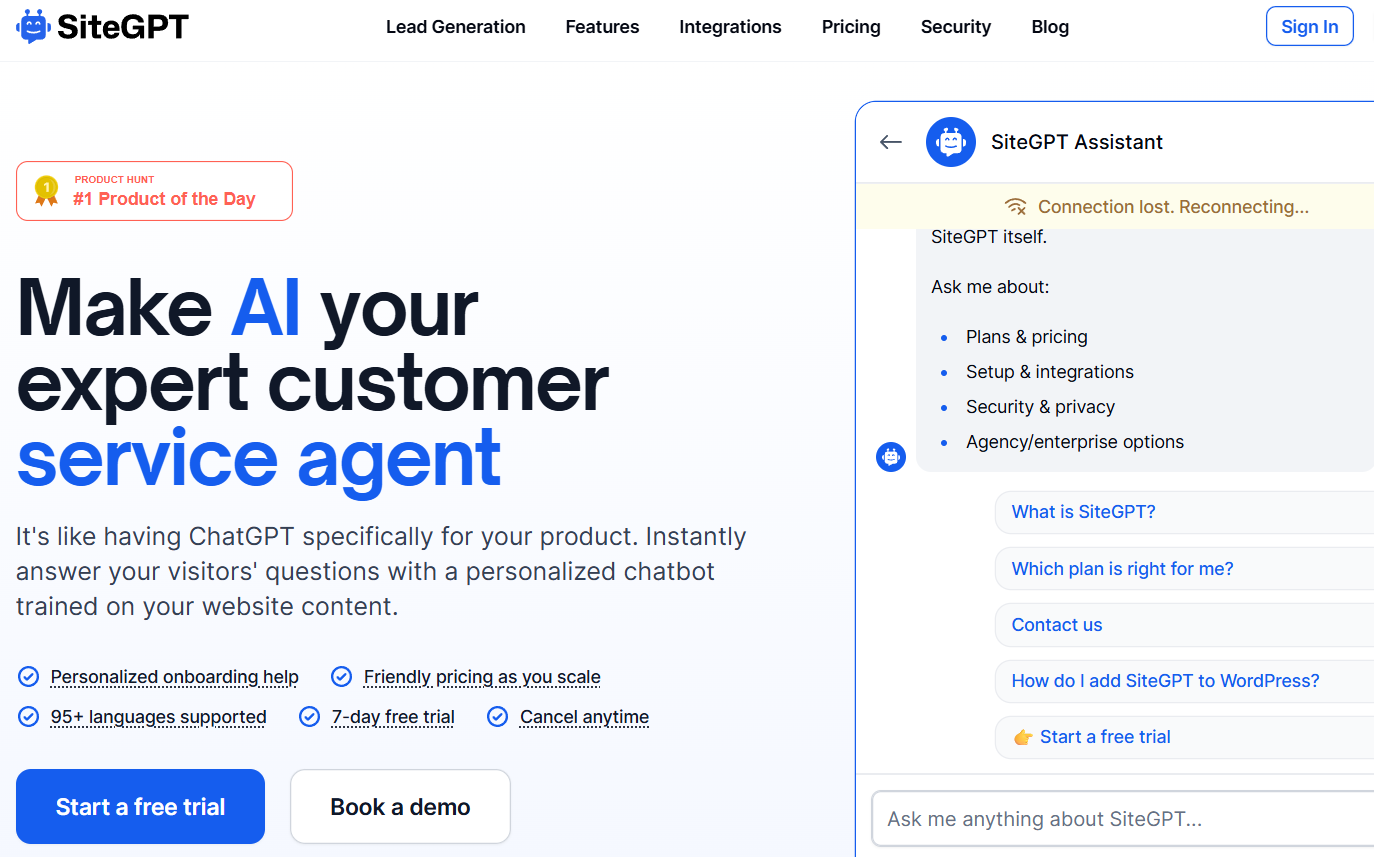
Bhanu launched on Product Hunt. Within the first two to three hours, SiteGPT was trending. By end of day it was the #1 product of the day and #4 product of the week. He crossed $10,000 MRR inside the first month — though roughly half those early users churned after month one, bringing revenue back to around $5,000 before it began compounding again. By six months in, SiteGPT was consistently clearing $13,000 to $15,000 monthly. When combined with continued income from Feather, Bhanu's annual revenue crossed $250,000 — all documented publicly across Starter Story, Superframeworks, and a Mixergy interview.
The solo founder constraints shaped the product. Bhanu couldn't build every feature fast, so he prioritised the thing that mattered most: the out-of-the-box experience. If the chatbot worked well on first use with zero configuration, the product sold itself. He tuned the onboarding until a non-technical user could go from URL to live chatbot in under five minutes. That frictionless demo loop drove word-of-mouth faster than any ad campaign.
- Used Product Hunt as a zero-cost launch runway. A well-timed PH launch with a genuinely useful tool — one that worked visibly on first try — delivered #1 product of the day and $10K MRR in 30 days. The audience was already there; the product just had to deserve it.
- Turned an existing product's side request into a new product. Bhanu didn't brainstorm a market. His existing Feather customers kept asking for the same thing. That inbound request was the product brief. If your current users keep asking for the same feature, that feature might be a business.
- Made the demo self-evident. Paste URL, click train, see chatbot answer questions. The product demonstrated its own value before anyone had to explain it. The closer your product's first use is to its core promise, the faster it converts.
- Built in public from India, for a global market. Bhanu shared his journey openly on X/Twitter (@pbteja1998), building an audience that cared about indie building. Every revenue update was a growth lever — the kind that doesn't cost a dollar.
- Listen to what your existing users keep asking for. SiteGPT wasn't a brainstorm — it was a repeated customer request that Bhanu finally decided to build as its own product. The demand signal was already there before a single line of code was written.
- First-use experience beats feature depth. Bhanu optimised ruthlessly for the demo: URL in, chatbot out, in under five minutes. Products that prove themselves on first touch spread without an advertising budget. The five-minute wow moment is a distribution strategy.
- $250K/year is reachable from one good problem solved well. Not a platform. Not a suite. One focused, useful tool that does its job on first try. Bhanu didn't build an AI company — he built a customer support shortcut and priced it accessibly for the businesses that needed it most.
Revenue figures tagged self-reported come directly from the founder's public posts or interviews — we don't audit them. Our purpose is to share success stories with enough online proof to be worth your attention, not to certify the numbers.